Basic Amateur Radio

Regulations and Policies
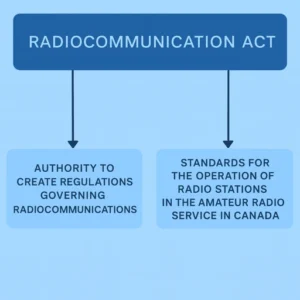
The Regulations and Policies module is a cornerstone of the Basic Qualification curriculum, providing learners with a detailed understanding of the legal and operational framework for amateur radio in Canada. This module covers all aspects of regulatory compliance, from obtaining and maintaining your amateur radio authorization to understanding international privileges and ITU regulations. It explains the rules for station identification, operational standards, and the restrictions on content and equipment use, ensuring learners understand the boundaries and responsibilities of their operating privileges.
Key topics include authorization requirements, eligibility criteria, terms and conditions of operation, and procedures for managing interference and emergency communications. Learners also explore the technical standards for frequency allocations, power restrictions, and RF safety, as well as the process for resolving disputes and managing antenna structure approvals. Additionally, the course delves into the unique aspects of international operation, such as reciprocal privileges and coordination with foreign operators, offering a global perspective on amateur radio practice.

The Canadian Amateur Radio Basic Qualification Exam evaluates the
foundational knowledge required to operate an amateur radio station in Canada.
The exam is organized into eight core subject areas covering
regulations, operating practices, safety, electronics, antennas, radio wave behavior,
and interference control.
After working through the questions in each section, candidates complete the
Final Exam, which consists of 100 questions randomly selected
from all sections.
Feedlines and Antenna Systems
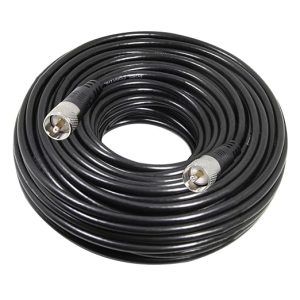
This section introduces the core principles of antenna behavior, starting with the relationship between wavelength and physical antenna length, and moving through practical antenna designs including verticals, Yagis, wires, and loops. Each lesson emphasizes how dimensions, impedance, gain, radiation patterns, and construction techniques shape antenna performance. From simple dipoles to complex arrays, this material builds the foundation for understanding how antennas radiate, how they can be tuned, and why their design choices matter for efficient amateur radio operation.
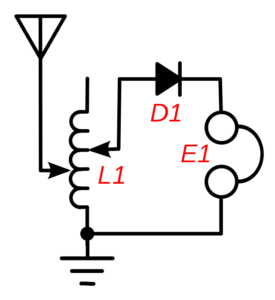
Electronics is the language of radio. To build, operate, and troubleshoot equipment, every amateur operator needs to understand the basic laws and components that make circuits work. In this section, you’ll explore the foundations of electricity—power, voltage, current, resistance—and how they come together through Ohm’s Law and the power law. You’ll also discover how capacitors, inductors, transformers, resonance, and impedance shape signals, and how meters make these invisible quantities visible. This knowledge is the starting point for mastering all future radio theory.
Operating Procedures in Amateur Radio
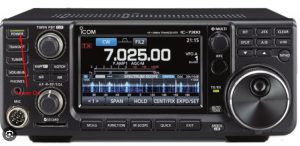
The Operating Procedures in Amateur Radio module provides learners with the foundational skills to communicate effectively across VHF, UHF, and HF bands. Covering topics like repeater and simplex communication, Morse code, Q signals, and emergency procedures, this course emphasizes the protocols and practices that ensure clear, respectful, and efficient amateur radio operations.
Each section introduces key concepts and their practical application, reinforced through the QSL (Question Specific Learning) methodology. Learners work through real-world scenarios, solidifying their understanding of operating etiquette, reporting systems, and record-keeping practices. This course equips participants with the knowledge needed to excel in the Basic Qualification exam and succeed in their amateur radio activities.
Station Assembly, Practice, and Safety
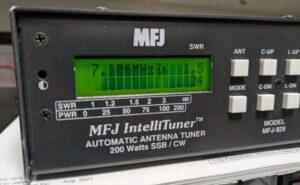
The Station Assembly, Practice, and Safety module introduces the key systems that make up an amateur radio station, including HF and FM equipment, digital modes, power supplies, and antennas. Using the QSL (Question Specific Learning) approach, it connects core theory with practical examples of how transmitters, receivers, and antennas work together. By the end, learners will understand how to assemble, operate, and safely maintain a station—knowledge that is essential both for the Basic Qualification exam and real-world operation.
Interference and Suppression
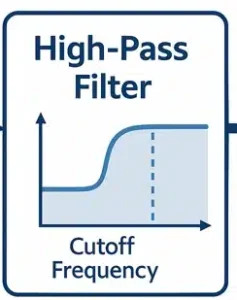
This section explains how transmitters can unintentionally generate unwanted signals and how to prevent them. Topics include front-end overload, audio rectification, intermodulation, spurious emissions, key-clicks, harmonics, splatter, transmitter adjustments, and the use of filters. Together, these lessons highlight the importance of clean signals, proper adjustment, and interference management in amateur radio.
Propagation
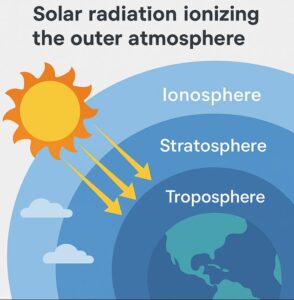
This section introduces the many ways radio waves travel through and around Earth’s atmosphere. Students learn about line-of-sight, ground wave, and ionospheric wave propagation, then explore more advanced effects like skip, fading, sporadic-E, aurora, tropospheric ducting, and scatter. The lessons explain how solar activity, sunspots, and the 11-year solar cycle shape HF conditions, while also showing how VHF and UHF signals can extend beyond line-of-sight through atmospheric effects. By understanding propagation, amateur operators can predict when bands will open, what frequencies will carry farthest, and why signals fade or distort.
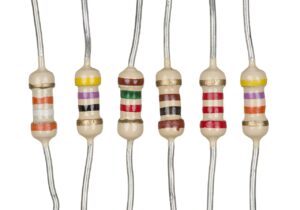
Every radio is built from a handful of basic circuit components that work together to control, shape, and move electrical signals. These parts may look simple on their own, but when combined, they create the amplifiers, receivers, and transmitters that make communication possible.
In this section, you’ll explore the key components used in amateur radio: resistors, capacitors, diodes, transistors, field-effect transistors, amplifiers, and vacuum tubes. By learning how each one functions and why it matters, you’ll gain the foundation to understand schematics, troubleshoot equipment, and see how simple parts form the complex systems at the heart of radio.