


Start Here
Codes and Protocols: Baudot, ASCII, Parity, CRC, X.25, ISO Layers
Unveiling Digital Mysteries: A Deep Dive into Codes and Protocols
In “Unveiling Digital Mysteries: A Deep Dive into Codes and Protocols,” the chapter embarks on an exploratory journey through the foundational digital codes and communication protocols integral to ham radio. It demystifies complex concepts such as Baudot, ASCII, parity checks, Cyclic Redundancy Check (CRC), and the intricacies of the X.25 standard and OSI model layers. This comprehensive examination is essential for anyone delving into digital modes of amateur radio, providing a clear understanding of the mechanisms behind data encoding, error detection, and structured communication protocols. By dissecting these technical elements, the chapter equips readers with the knowledge necessary to navigate the digital landscape of ham radio, enhancing their ability to engage in advanced digital communications effectively.

Varicode’s Unique Element Lengths: Question (A-005-008-001)
Understanding Varicode’s Element Length Variation
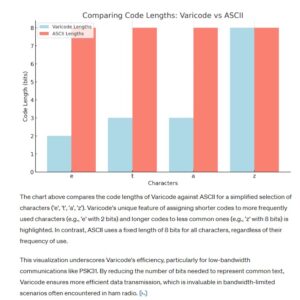
Question (A-005-008-001) delves into identifying a digital code characterized by elements of unequal lengths. The correct answer, A. Varicode, highlights Varicode’s unique feature. Varicode is designed with efficiency in mind, particularly for low-bandwidth communications like PSK31. Unlike fixed-length codes like ASCII or Baudot, Varicode assigns shorter codes to more frequently used characters and longer codes to less common ones. This variation in code length allows for more efficient data transmission, as it reduces the overall number of bits needed to represent common text, making it especially useful in bandwidth-limited scenarios often encountered in ham radio.
Parallels:
- Morse Code in Telegraphy: Similar to how Morse code assigns shorter sequences to more common letters (e.g., ‘E’ is just a dot), Varicode assigns shorter codes to frequently used characters for efficiency.
- Shorthand Writing: In shorthand writing, frequently used words or phrases are represented by shorter symbols, analogous to Varicode’s approach in digital communication.
Question Summary and Key Takeaways:
- Unique Feature of Varicode: Varicode uses elements of unequal lengths, differing from fixed-length codes.
- Efficiency in Representation: Shorter codes for common characters lead to more efficient data transmission.
- Ideal for Low-Bandwidth Communication: Particularly useful in ham radio modes like PSK31 where bandwidth is limited.
- Variable Length Coding: This approach reduces the overall bit count needed for common text.
- Application in Digital Modes: Understanding Varicode is important for operators using digital modes in ham radio.

The OSI Model’s Foundation: (A-005-008-002)
The Physical Layer in the OSI Model and Ham Radio
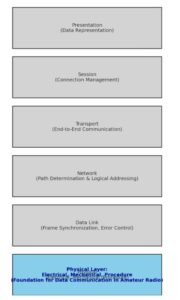
Question (A-005-008-002) focuses on identifying the base layer of the Open Systems Interconnection (OSI) model as it applies to the structure of amateur digital radio systems. The correct answer, C. The physical layer, is fundamental in the OSI model, which standardizes the various functions of a data communications system. In the context of amateur radio, particularly when connecting a packet radio Terminal Node Controller (TNC) to a computer terminal, the physical layer is paramount. It deals with the physical aspects of data transmission, such as the electrical and mechanical properties of the connection and the medium used for communication. This layer forms the foundation upon which other layers and functionalities are built, making it crucial for ham radio operators to understand its role in ensuring effective and reliable data communication.
Parallels:
- Foundations in Building Construction: The physical layer in the OSI model is akin to the foundation of a building, crucial for supporting all other structures above it.
- Roads in Transportation Networks: Just as roads are fundamental for transportation, the physical layer forms the basic infrastructure for data transmission in ham radio systems.
Question Summary and Key Takeaways:
- Base Layer of OSI Model: The physical layer is the foundational layer in the OSI model.
- Role in Amateur Radio: It handles the physical connection between devices, like a TNC and a computer.
- Focus on Physical Properties: The layer is concerned with electrical, mechanical, and physical aspects of transmission.
- Importance in Data Communication: Understanding this layer is key for effective data transmission in ham radio.
- Foundation for Higher Layers: It forms the base upon which other communication functions are built.
Error Detection with CRC (A-005-008-003)
The Role of Cyclic Redundancy Check in Data Integrity
Question (A-005-008-003) addresses the purpose of a Cyclic Redundancy Check (CRC). The correct answer, A. Error detection, points out CRC’s crucial role in maintaining data integrity in digital communication, especially in ham radio. CRC is a method used to detect errors in transmitted data. It involves generating a short, fixed-length binary sequence, known as a checksum, from the data at the sending end. This checksum is then transmitted along with the data. At the receiving end, the CRC algorithm recalculates the checksum to verify if it matches the one sent. If there is a mismatch, it indicates that an error occurred during transmission. CRC is effective in detecting common types of errors like bit flips and missing bits, making it a vital tool in error detection for digital modes of ham radio communication.
Parallels:
- Quality Check in Manufacturing: CRC in data transmission is similar to a quality check in manufacturing, where products are inspected for defects before shipment.
- Proofreading a Document: Like proofreading a document for errors, CRC checks data integrity to ensure accurate communication.
Question Summary and Key Takeaways:
- Purpose of CRC: Cyclic Redundancy Check is used for error detection in digital data transmission.
- Checksum Generation: CRC involves creating a checksum from the data, which is checked at the receiving end.
- Error Indication: A mismatch in checksums indicates errors in the transmitted data.
- Common in Digital Communication: CRC is widely used in digital modes of ham radio.
- Importance for Data Integrity: Understanding and implementing CRC is crucial for maintaining the integrity of digital communications.
ASCII vs. Baudot Code (A-005-008-004)
Advantages of ASCII in Text Communication
Question (A-005-008-004 explores the benefits of using ASCII over Baudot code. The correct answer, B. It includes both upper and lower case text characters in the code, highlights a significant advantage of ASCII. ASCII (American Standard Code for Information Interchange) is more versatile than Baudot code because it includes a larger character set, encompassing both upper and lower case letters. This expanded character set allows for more expressive and varied text communication, which is particularly beneficial in digital modes of ham radio. Baudot code, with its limitation to a smaller set of characters, lacks this capability. The inclusion of both case variants in ASCII makes it a preferred choice for modern digital communication systems in amateur radio.
Parallels:
- Extended Palette in Art: ASCII’s expanded character set compared to Baudot code is like having a more extensive palette of colors in art, allowing for richer expression.
- Upgraded Library in Research: Using ASCII over Baudot is akin to accessing a more comprehensive library for research, offering greater information and versatility.
Question Summary and Key Takeaways:
- Expanded Character Set: ASCII includes both upper and lower case letters, unlike Baudot code.
- Versatility in Communication: This makes ASCII more versatile and expressive for text communication.
- Advantage in Digital Modes: ASCII’s expanded set is particularly beneficial in digital modes of ham radio.
- Preference for Modern Systems: ASCII is generally preferred in modern digital communication systems.
- Enhanced Expressiveness: Understanding the benefits of ASCII is important for effective digital communication in amateur radio.
Error Control in AMTOR ARQ (A-005-008-005)
Automatic Repeat Request in AMTOR ARQ (Mode A)
Question (A-005-008-005) inquires about the type of error control system used in AMTOR ARQ (Mode A). The correct answer, C. The receiving station automatically requests repeats when needed, describes the fundamental mechanism of AMTOR ARQ (Automatic Repeat reQuest). In this mode, the receiving station plays an active role in error control by monitoring for errors and automatically requesting the retransmission of any erroneous data. This process enhances the reliability of the communication, as it ensures that only error-free data is accepted. AMTOR ARQ’s method of error control is particularly effective in conditions where the signal may be prone to interference or degradation, making it a valuable mode in various ham radio operations.
Parallels:
- Asking for Clarification in Conversation: This is akin to asking for clarification in a conversation when something is not heard or understood correctly.
- Quality Control in Production: Similar to a quality control process where flawed products are sent back for rework.
Question Summary and Key Takeaways:
- Error Control in AMTOR ARQ: The receiving station automatically requests repeats for erroneous data.
- Enhanced Communication Reliability: This method ensures the accuracy and reliability of the received data.
- Active Role of Receiver: The receiver actively checks for and responds to errors in the transmission.
- Useful in Varied Conditions: Particularly effective in environments with signal interference.
- Importance in Ham Radio: Understanding AMTOR ARQ’s error control is crucial for effective digital communication in amateur radio.
Error Correction in AMTOR FEC (A-005-008-006)
Duplicate Transmission in AMTOR FEC (Mode B)
Question (A-005-008-006) explores the error-correction system used in AMTOR FEC (Forward Error Correction, Mode B). The correct answer, A. Each character is sent twice, explains the fundamental error-correction approach in this mode. In AMTOR FEC, each character is transmitted twice as a redundancy measure. This duplication allows the receiving station to compare the two instances of each character and correct errors by choosing the most likely correct version. This method increases the likelihood of accurate data reception, especially in conditions where the signal may be subject to interference. While this approach does not involve active requests for retransmission like in ARQ, it provides a level of error correction that can be critical in maintaining the integrity of communications in various ham radio scenarios.
Parallels:
- Double-Checking Work in Academics: This is similar to double-checking answers in a test to ensure accuracy.
- Backup Systems in Technology: Like having backup systems in technology, sending each character twice provides a fail-safe against errors.
Question Summary and Key Takeaways:
- Redundancy in Transmission: Each character is sent twice in AMTOR FEC (Mode B) for error correction.
- Self-Correction Mechanism: The duplication allows for comparison and correction of errors at the receiver.
- Increased Accuracy: This method enhances the likelihood of accurate data reception.
- Useful in Interference Conditions: Effective in scenarios where the signal is prone to interference.
- Significance for Ham Radio Operators: Understanding this error correction method is important for effective use of AMTOR FEC in amateur radio.
APRS Functions and Limitations (A-005-008-007)
Understanding the Capabilities of APRS
Question (A-005-008-007) addresses the functions not supported by the Automatic Packet Reporting System (APRS). The correct answer, B. Automatic link establishment, highlights a limitation in the capabilities of APRS. APRS is widely used in amateur radio for applications like two-way messaging, telemetry, and broadcasting amateur-specific local information. However, it does not inherently support automatic link establishment. APRS operates in an unconnected broadcast mode, meaning it sends data out without establishing a dedicated two-way connection between stations. Understanding the functionalities and limitations of APRS is crucial for ham radio operators, as it informs their decisions on how to best use this system for various communication and tracking applications.
Parallels:
- Broadcast TV vs. Phone Calls: APRS’s broadcast mode is like a TV broadcast, sending information out broadly, unlike a phone call which establishes a two-way link.
- Public Announcement System: Similar to a public announcement system that broadcasts messages to a wide audience without direct feedback or connection.
Question Summary and Key Takeaways:
- APRS Limitation: Does not support automatic link establishment.
- Supported Functions: Used for two-way messaging, telemetry, and local information broadcast.
- Unconnected Broadcast Mode: APRS operates by sending data without a dedicated two-way connection.
- Application in Amateur Radio: Understanding its capabilities is key for effective use in ham radio.
- Informed Usage Decisions: Knowledge of APRS functions and limitations aids in its optimal application.
Cyclic Redundancy Check Algorithm: (A-005-008-008)
Generating CRC with Hash Functions
Question (A-005-008-008) delves into the algorithm used for creating a Cyclic Redundancy Check (CRC). The correct answer, A. Hash function, points out the mathematical process behind CRC generation. CRC is a vital tool in digital communications, including ham radio, for ensuring data integrity. It’s accomplished by applying a hash function, a specific type of algorithm that processes data and outputs a hash value, a fixed-size string of bytes. This hash value, or checksum, is a sort of digital signature for data blocks, providing a means to verify data integrity upon reception.
In ham radio, especially in digital modes where accurate data transmission is crucial, the CRC serves as a guard against data corruption during transmission. When data is sent, the CRC value is calculated and sent along with it. Upon receipt, the same hash function is applied to the received data to generate a new CRC value. This new value is then compared to the original CRC value sent with the data. If they match, it is highly likely that the data was transmitted without error. If they do not match, this indicates that the data has been altered or corrupted in transit.
The use of hash functions in CRC generation is a powerful method because of their unique property: even a small change in the input data results in a significantly different hash value. This sensitivity makes CRC a reliable method for error detection in digital communication systems.
Parallels:
- Checksum in Banking: CRC’s use of hash functions can be compared to how banks use checksums to ensure the accuracy of account numbers. Just as a small error in the account number is detected by an incorrect checksum, CRC identifies even minor alterations in data.
- Digital Fingerprinting: The CRC process is akin to creating a digital fingerprint of data. Like a fingerprint uniquely identifies a person, the CRC provides a unique identifier for a block of data, which can be used to detect any changes or corruption.
Question Summary and Key Takeaways:
- CRC Generation: CRCs are generated using hash functions, which are algorithms that convert data into a fixed-size hash value or checksum.
- Role in Data Integrity: The primary role of CRC is to detect any changes in the data, ensuring its integrity during transmission.
- Importance in Digital Communication: CRC is crucial in digital communication systems, including ham radio, for error detection.
- Sensitivity to Data Changes: Hash functions used in CRC are highly sensitive to changes in the data, making them effective for error detection.
- Verification Process: The CRC verification process involves comparing the transmitted CRC value with a newly calculated one at the receiving end to detect errors.
The Packet Radio Protocol AX.25 (A-005-008-009)
Associating AX.25 with Amateur Radio Modes
Question (A-005-008-009) seeks to identify the amateur radio mode associated with the designator AX.25. The correct answer, C. Packet, places AX.25 within the context of packet radio communications, a mode extensively used in amateur radio. AX.25, a protocol derived from the X.25 protocol used in early internet and computer networks, is specifically adapted for amateur radio packet communications. It defines how data is formatted and transmitted over amateur radio, providing a framework for error detection and addressing.
In ham radio, packet radio is a method of digital communication that uses packet switching technology. Each data packet, encapsulated according to the AX.25 protocol, contains not only the user’s data but also addressing and error-checking information. This protocol allows for efficient and reliable data transmission, even under the fluctuating conditions typical in radio communications. The use of AX.25 in amateur radio packet mode exemplifies how ham radio operators leverage established data communication protocols, adapting them to the unique requirements and challenges of radio wave propagation and amateur radio regulations.
Parallels:
- Postal System for Mail Delivery: AX.25 in packet radio can be likened to the postal system for mail delivery. Just as the postal system has specific formats for addressing and sending parcels, AX.25 provides a standardized way to package and transmit data in amateur radio.
- Traffic Rules in Road Networks: The role of AX.25 in packet radio is similar to traffic rules in road networks, providing the guidelines and structure necessary for the orderly and efficient flow of data packets.
Question Summary and Key Takeaways:
- AX.25 in Packet Radio: The AX.25 protocol is primarily associated with the packet radio mode in amateur radio.
- Adaptation from X.25 Protocol: AX.25 is an adaptation of the X.25 protocol, tailored for amateur radio use.
- Data Formatting and Transmission: It defines the structure for data packets, including formatting, addressing, and error detection.
- Efficient Data Communication: AX.25 facilitates efficient and reliable data transmission in variable radio conditions.
- Standardization in Amateur Radio: The use of AX.25 demonstrates how established protocols can be adapted to meet the specific needs of ham radio operations.
Baudot Code’s Character Limitation (A-005-008-010)
Baudot Code and Its 5-bit Structure
Question (A-005-008-010) focuses on the number of information bits included in the Baudot code. The correct answer is D. 5, which points to the inherent limitations of the Baudot code’s design. Developed in the 19th century, the Baudot code was one of the earliest forms of digital communication codes and used a fixed-length 5-bit binary code to represent characters. This configuration limits the Baudot code to 32 different characters (2^5 combinations), encompassing letters, a few control characters, and no numerals or lowercase letters.
The Baudot code’s 5-bit structure was a significant advancement in telegraphy, enabling more efficient communication than Morse code. However, its limited character set became a constraint with the advent of more complex digital communications. In modern contexts, including ham radio, more comprehensive coding systems like ASCII are used, which provide larger character sets, including both upper and lower case letters, numbers, and a variety of symbols and control characters. The transition from the Baudot code to more advanced systems reflects the evolution of digital communication needs and technology.
Parallels:
- Early Automobiles: The Baudot code can be likened to early automobiles, which were revolutionary in their time but limited compared to modern vehicles’ capabilities.
- Vintage Computers: Similarly, the Baudot code is reminiscent of vintage computers, which had groundbreaking technology for their era but are limited by today’s standards.
Question Summary and Key Takeaways:
- 5-bit Binary Structure: The Baudot code uses a 5-bit structure, allowing for 32 different character representations.
- Early Digital Communication: It represents an early stage in the development of digital communication codes.
- Limited Character Set: The Baudot code’s character set is limited, lacking numerals and lowercase letters.
- Advancement in Telegraphy: Though an advancement over Morse code, it was surpassed by more versatile coding systems.
- Evolution to Modern Codes: The move from Baudot to systems like ASCII reflects the evolving needs and capabilities in digital communication.
ASCII Code’s Extended Functionality (A-005-008-011)
Exploring the Enhanced Capacity of ASCII Code
Question (A-005-008-011) asks about the number of information bits in the ISO-8859 extension to the ASCII code. The correct answer is B. 8, which highlights the expanded capabilities of the ASCII code through the ISO-8859 extension. ASCII, originally a 7-bit code allowing for 128 different characters, was extended to 8 bits in the ISO-8859 standard. This expansion increases the character set to 256, enabling the inclusion of additional symbols, diacritics, and other language-specific characters. This enhancement is particularly significant in the context of global communication, where the need to represent a wider array of characters and symbols becomes essential.
The shift from 7 to 8 bits in ASCII code reflects a broader evolution in digital communication, catering to more complex and diverse linguistic requirements. In ham radio, this extended ASCII code allows for more versatile text communication, accommodating various languages and special characters. This adaptability is crucial in amateur radio’s global community, where operators frequently exchange information across different languages and cultures.
Parallels:
- Expanding a Library’s Catalog: The enhancement of ASCII to 8 bits is akin to expanding a library’s catalog, allowing for a wider range of books and resources to be included.
- Upgrading a Toolset: This extension can be compared to upgrading a basic toolset with additional, specialized tools, greatly enhancing its functionality and versatility.
Question Summary and Key Takeaways:
- Extension to 8 Bits: The ISO-8859 extension expands ASCII to 8 bits, doubling the number of representable characters.
- Increased Character Set: This expansion allows for 256 different characters, including special and language-specific symbols.
- Global Communication Enhancement: The extended ASCII is crucial for accommodating diverse languages and symbols in global communication.
- Adaptability in Ham Radio: The 8-bit ASCII code enhances text communication capabilities in the amateur radio community.
- Evolution of Digital Coding: The shift from 7 to 8 bits in ASCII reflects the ongoing evolution and adaptation in digital communication technologies.